
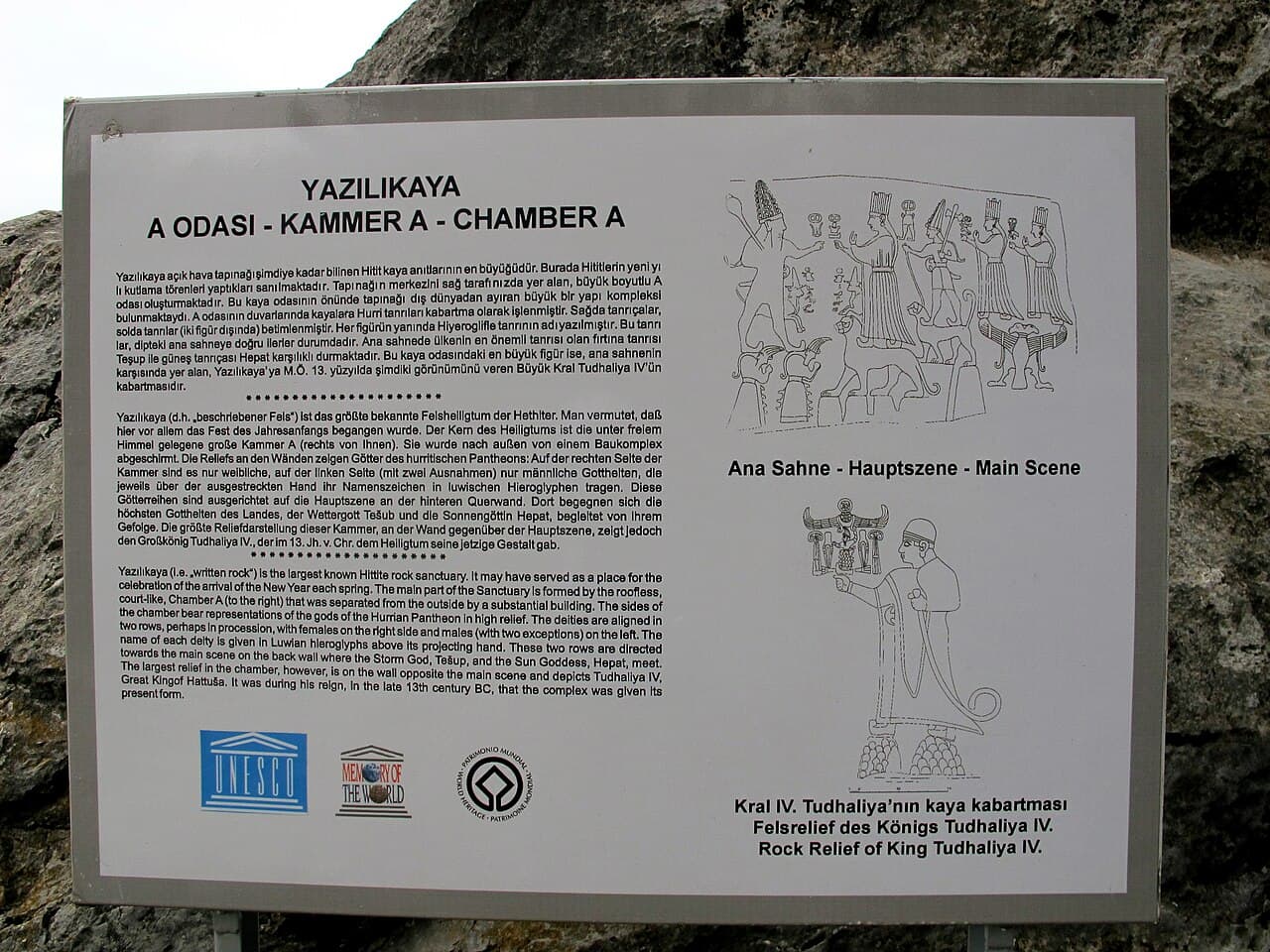
Hattusha's most impressive holy site is the Open-Air Temple of Yazılıkaya (Yazılıkaya Açık Hava Tapınağı), hidden among the high cliffs slightly outside the city. In this open-air temple used for New Year celebrations of the period, the country's important gods and goddesses are engraved in rows as reliefs on the rock. Yazılıkaya that can be visited in two sections, rooms A and B, reflects the Hittite pantheon (all ancient Gods and Goddesses) with its majestic rock descriptions. It is thought that Yazılıkaya, considered the national temple of the Hittite Empire, was isolated from the outside world by a wall during the first construction period; its second phase and the reliefs in the Grand Gallery have been built at the time of Hattusili III, and the Tudhaliya relief in the Grand Gallery, Small Gallery and the third phase of the temple at the time of Tudhaliya IV. The national temple of the Hittite Empire, now called Yazılıkaya, is located two kilometers northeast of Hattuşaş (Boğazköy). In front of this cult site, an open-air temple built on natural rock, there are temple structures built later and belonging to three different periods. In the first period, a siege wall was built that isolated the rock temple from the outside world, in the second phase a temple was added in the Hittite tradition along with the monumental entrance structure, in the third period, the eastern wing of the main structure was transformed into a more useful entrance in front of the Small Gallery. In the relief of twelve underground gods, which are the first figures of Room A, the meeting of God Teshub and Goddess Hepat, the main subject on the back wall, is seen. At the end of the goddess figures, opposite the main scene, there is Tudhaliya IV, the greatest figure of this open-air temple.
Visitor reviews
No reviews yet. Be the first!